What Is the 80/20 Rule for EV Charging?
Electric vehicles (EVs) are becoming increasingly popular in India thanks to lower running costs, government incentives, and growing charging infrastructure. However, many new EV owners have one common question: What is the 80/20 rule for EV charging?
If you have recently purchased an EV or are planning to buy one, understanding this rule can help you maximize battery life, maintain performance, and reduce long-term ownership costs.
The 80/20 charging rule is one of the most widely recommended battery management practices for lithium-ion batteries used in modern electric vehicles. While it is not a strict law, following it can significantly improve battery health over the years.
In this detailed guide, we will explain the 80/20 rule, why it matters, how it affects battery degradation, and whether Indian EV owners should follow it in daily driving.
Quick Summary Table
| Factor | Details |
|---|---|
| Rule Name | 80/20 EV Charging Rule |
| Recommended Charge Level | Charge up to 80% for daily use |
| Recommended Minimum Level | Avoid regularly dropping below 20% |
| Purpose | Improve battery lifespan |
| Battery Type | Lithium-ion batteries |
| Best For | Daily commuting |
| Full Charging Allowed? | Yes, for long trips |
| Main Benefit | Reduced battery degradation |
| Applicable To | Most modern EVs |
Understanding the 80/20 Rule
The 80/20 rule for EV charging means:
- Try to keep your battery charge between 20% and 80% during normal usage.
- Avoid regularly charging to 100%.
- Avoid frequently draining the battery below 20%.
This charging range is considered the “sweet spot” for lithium-ion batteries.
For example:
- Charge your EV when it reaches around 20%.
- Stop charging at approximately 80%.
- Use the remaining capacity only when necessary.
Many EV manufacturers recommend similar charging habits because lithium-ion batteries experience less stress within this range.
Why EV Batteries Prefer the 20%–80% Range
Lithium-ion batteries are highly efficient but sensitive to extreme charge levels.
When a battery is charged close to 100% or discharged close to 0%, chemical stress inside the cells increases. Over time, this stress can accelerate battery degradation.
Charging Above 80%
When charging beyond 80%:
- Battery temperature may rise.
- Charging speed often slows down.
- Cell voltage increases.
- Long-term degradation can accelerate.
Going Below 20%
Frequently allowing the battery to fall below 20% can:
- Increase stress on battery cells.
- Cause deeper discharge cycles.
- Reduce overall battery longevity.
Keeping the battery between 20% and 80% minimizes these issues.
How Lithium-Ion EV Batteries Work
To understand the 80/20 rule better, it helps to know how EV batteries function.
Modern electric vehicles use lithium-ion battery packs consisting of thousands of individual cells.
During charging:
- Lithium ions move toward the anode.
- Energy is stored inside the battery.
During driving:
- Lithium ions move back.
- Energy powers the electric motor.
Each charging and discharging cycle causes a tiny amount of wear.
Over thousands of cycles, this wear accumulates and gradually reduces battery capacity.
The 80/20 rule helps slow down this natural aging process.
Battery Degradation Explained
Battery degradation refers to the gradual loss of battery capacity over time.
For example:
A new EV battery may provide:
- 400 km range when new
After several years:
- 360 km range
- 340 km range
- 320 km range
This decline is normal.
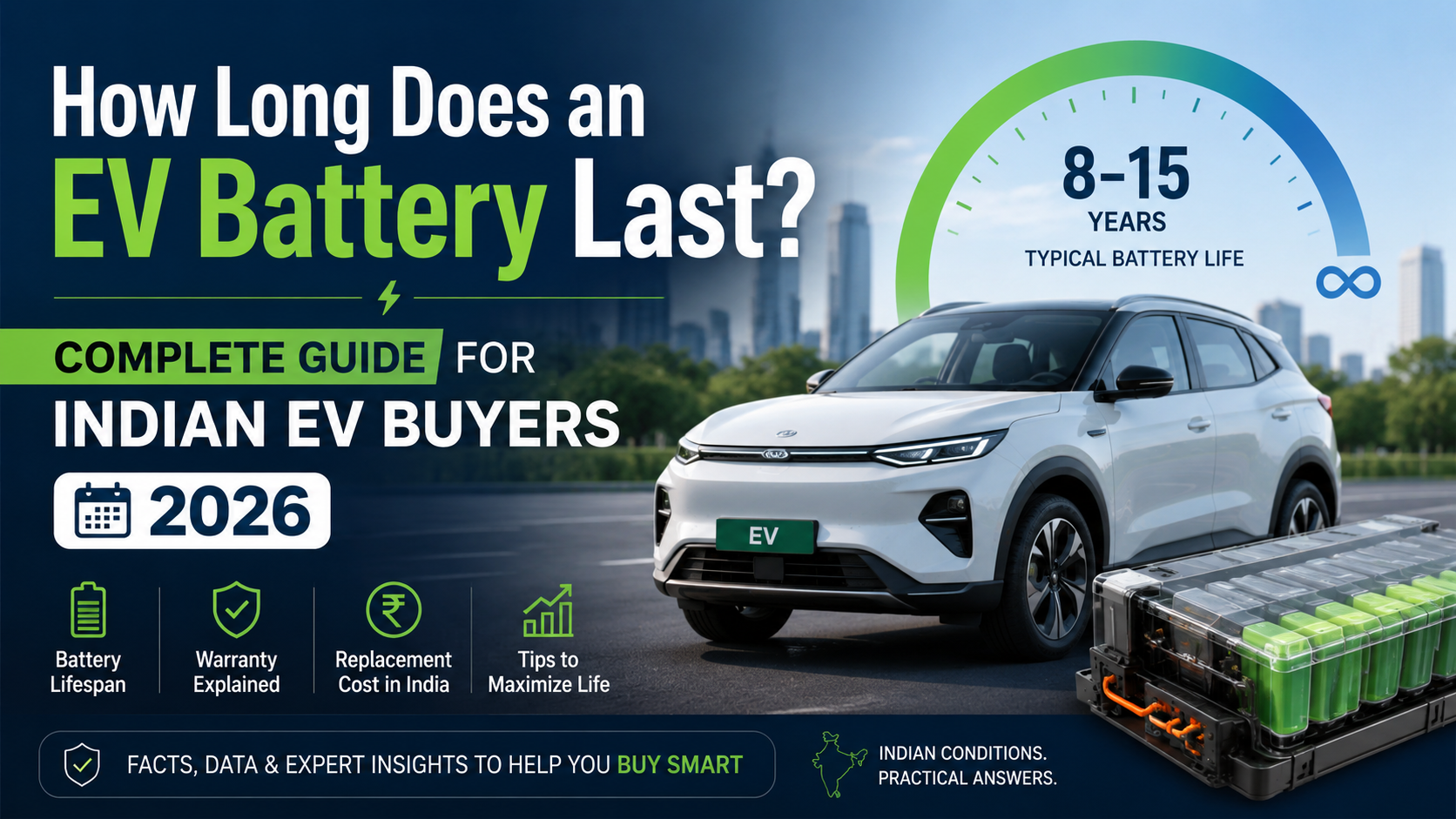
However, charging habits significantly affect how quickly degradation occurs.
Factors That Affect EV Battery Life
High State of Charge
Keeping the battery near 100% for long periods can increase wear.
Deep Discharge
Frequently running the battery near 0% increases stress.
Fast Charging
Excessive DC fast charging can contribute to battery heating.
Extreme Temperatures
Very hot weather, common in many Indian states, can accelerate degradation.
Charging Habits
Following the 80/20 rule can reduce long-term battery stress.
Benefits of Following the 80/20 Rule
1. Longer Battery Life
This is the biggest advantage.
The battery experiences less chemical stress, helping it retain capacity for more years.
2. Better Long-Term Range
A healthier battery maintains more of its original range.
This means your EV remains practical for a longer period.
3. Reduced Heat Generation
Charging to 80% usually produces less heat than charging to 100%.
Heat is one of the biggest enemies of battery health.
4. Improved Charging Efficiency
Most EVs charge fastest between low and medium charge levels.
Charging slows significantly near full capacity.
Stopping at 80% can save time.
5. Better Resale Value
A well-maintained battery can improve resale value.
Potential buyers often consider battery condition when purchasing a used EV.
Drawbacks of the 80/20 Rule
While beneficial, the rule is not perfect.
1. Reduced Available Range
You are not using the battery’s full capacity daily.
For example:
- 100% charge = 400 km
- 80% charge = 320 km
You lose some usable range.
2. Requires Planning
Drivers must monitor charging habits more carefully.
3. Not Always Practical
People who drive long distances daily may need the full battery capacity.
Is Charging to 100% Bad?
A common misconception is that charging to 100% is harmful.
The truth is more nuanced.
Charging to 100% occasionally is completely normal.
You should consider charging to 100% when:
- Going on a road trip
- Traveling long distances
- Driving in remote areas
- Needing maximum range
The issue arises when the battery stays at 100% for extended periods every day.
Most experts recommend:
- 80% for daily use
- 100% only when necessary
Should You Follow the Rule in India?
For most Indian EV owners, the answer is yes.
Ideal Users
The 80/20 rule works especially well for:
- City commuters
- Office-goers
- Daily users
- Families using EVs for local travel
If your daily driving is:
- 30 km
- 50 km
- 80 km
Then charging to 80% is usually sufficient.
Users Who May Need 100%
You may regularly charge to full if:
- You drive over 250 km daily
- You frequently travel on highways
- Charging stations are limited in your area
Does Every EV Need the 80/20 Rule?
Most modern EVs already include sophisticated Battery Management Systems (BMS).
These systems:
- Protect the battery
- Prevent overcharging
- Manage temperature
- Balance battery cells
Because of this, modern EVs are more tolerant than older battery technologies.
Popular Indian EVs such as:
- Tata Nexon EV
- Tata Curvv EV
- Tata Tiago EV
- MG Windsor EV
- Mahindra BE Series
- Hyundai Creta Electric
all use advanced battery management systems.
However, following the 80/20 rule can still provide additional long-term benefits.
Fast Charging and the 80/20 Rule
Many EV owners notice that DC fast charging slows dramatically after 80%.
This happens because:
- Battery voltage increases.
- Heat management becomes critical.
- The BMS protects battery health.
As a result:
- 20% to 80% may take 30 minutes.
- 80% to 100% may take another 20–30 minutes.
For this reason, many EV drivers stop charging at 80% during road trips.
This often results in faster overall travel times.
Best EV Charging Practices
Charge Overnight Using AC Charging
Slow charging generates less heat and is generally better for battery health.
Avoid Frequent Deep Discharges
Do not routinely let the battery drop below 10%.
Limit Unnecessary Fast Charging
Use DC fast charging when needed, not for every charging session.

Park in Shade
Indian summers can be extremely hot.
Keeping the vehicle cooler helps battery longevity.
Use Manufacturer Recommendations
Always follow guidance from your EV manufacturer.
Enable Charge Limits
Many modern EVs allow owners to set a charging limit of 80%.
Use this feature whenever possible.
Comparison: 80% Charging vs 100% Charging
| Parameter | Charge to 80% | Charge to 100% |
|---|---|---|
| Battery Life | Better | Slightly lower over time |
| Daily Use | Excellent | Good |
| Available Range | Lower | Maximum |
| Charging Time | Faster | Slower |
| Heat Generation | Lower | Higher |
| Road Trips | Less suitable | Best option |
| Long-Term Battery Health | Better | Moderate |
Key Features of the 80/20 Charging Strategy
- Helps extend battery lifespan
- Reduces battery stress
- Minimizes degradation
- Improves long-term range retention
- Works with most EVs
- Supports efficient charging habits
- Particularly useful for city driving
- Recommended by many EV experts
Specifications
Since the 80/20 rule is a charging strategy rather than a product, traditional specifications do not apply.
However, the key parameters are:
| Specification | Value |
|---|---|
| Recommended Upper Limit | 80% |
| Recommended Lower Limit | 20% |
| Battery Type | Lithium-ion |
| Applicable Vehicles | Electric Vehicles |
| Main Objective | Battery Longevity |
| Charging Method | AC and DC Charging |
Who Should Follow the 80/20 Rule?
Ideal For
- First-time EV owners
- Daily commuters
- Urban drivers
- Fleet operators
- Ride-sharing drivers
- Families with predictable travel patterns
May Not Be Necessary For
- Frequent highway travelers
- Commercial users requiring maximum range daily
- Drivers with limited charging access
Expert Analysis
From an automotive journalist’s perspective, the 80/20 rule remains one of the simplest and most effective ways to preserve EV battery health.
Modern EV batteries are far more durable than many people think. Most manufacturers provide battery warranties ranging from 8 years to 10 years. However, battery replacement remains one of the most expensive ownership costs.
By following the 80/20 charging approach, owners can potentially slow battery degradation and maintain better range retention over the vehicle’s lifetime.
That said, EV owners should not become overly worried about charging habits. The occasional 100% charge is perfectly acceptable and often necessary for long-distance travel.
The goal is balance rather than strict adherence.
Frequently Asked Questions (FAQs)
1. What is the 80/20 rule in EV charging?
The 80/20 rule means keeping your EV battery between 20% and 80% charge for daily use to reduce battery stress and improve long-term battery health.
2. Is it bad to charge an EV to 100%?
No. Charging to 100% occasionally is completely safe. However, doing it every day and leaving the battery at full charge for long periods may increase battery degradation over time.
3. Should I always stop charging at 80%?
For daily driving, stopping at 80% is generally recommended. For long trips, charging to 100% is perfectly reasonable.
4. Does fast charging damage EV batteries?
Occasional fast charging is safe. However, relying exclusively on DC fast charging may increase battery wear compared to regular AC charging.
5. How long do EV batteries last?
Most modern EV batteries are designed to last 8–15 years and often exceed 2,00,000 km of driving under normal conditions.
6. Can I drive below 20% battery?
Yes. The 20% limit is a guideline, not a strict rule. Occasionally driving below 20% is fine, but repeatedly doing so may increase battery stress.
7. Do all EV manufacturers recommend the 80/20 rule?
Not all manufacturers state it directly, but many recommend limiting daily charging and avoiding extreme charge levels whenever practical.
Conclusion
The 80/20 rule for EV charging is a simple yet effective practice that can help extend battery life, improve long-term range retention, and reduce battery degradation. By keeping your electric vehicle’s battery between 20% and 80% during regular use, you minimize stress on lithium-ion cells and support healthier battery performance over time.
For most Indian EV owners who primarily drive within cities, following this rule makes excellent sense. However, charging to 100% is completely acceptable when preparing for long-distance travel or when extra range is needed.
Ultimately, the best approach is to use the 80/20 rule as a guideline rather than a strict requirement. Combined with sensible charging habits, moderate use of fast chargers, and proper vehicle care, it can help you get the maximum life and value from your EV battery for many years to come.