Electric vehicles (EVs) are becoming increasingly popular in India due to rising fuel prices, lower running costs, and government support for cleaner transportation. While public charging infrastructure is expanding, most EV owners prefer charging their vehicles at home because it is convenient, cost-effective, and available whenever needed.
Setting up a home EV charging station may seem complicated at first, but the process is actually straightforward when planned properly. Whether you own a Tata Tiago EV, Tata Nexon EV, MG Windsor EV, Mahindra BE.06, Hyundai Creta Electric, or any other electric car, understanding the basics of home charging can help you make the right decisions.
This comprehensive guide explains everything Indian EV buyers need to know about setting up EV charging at home.
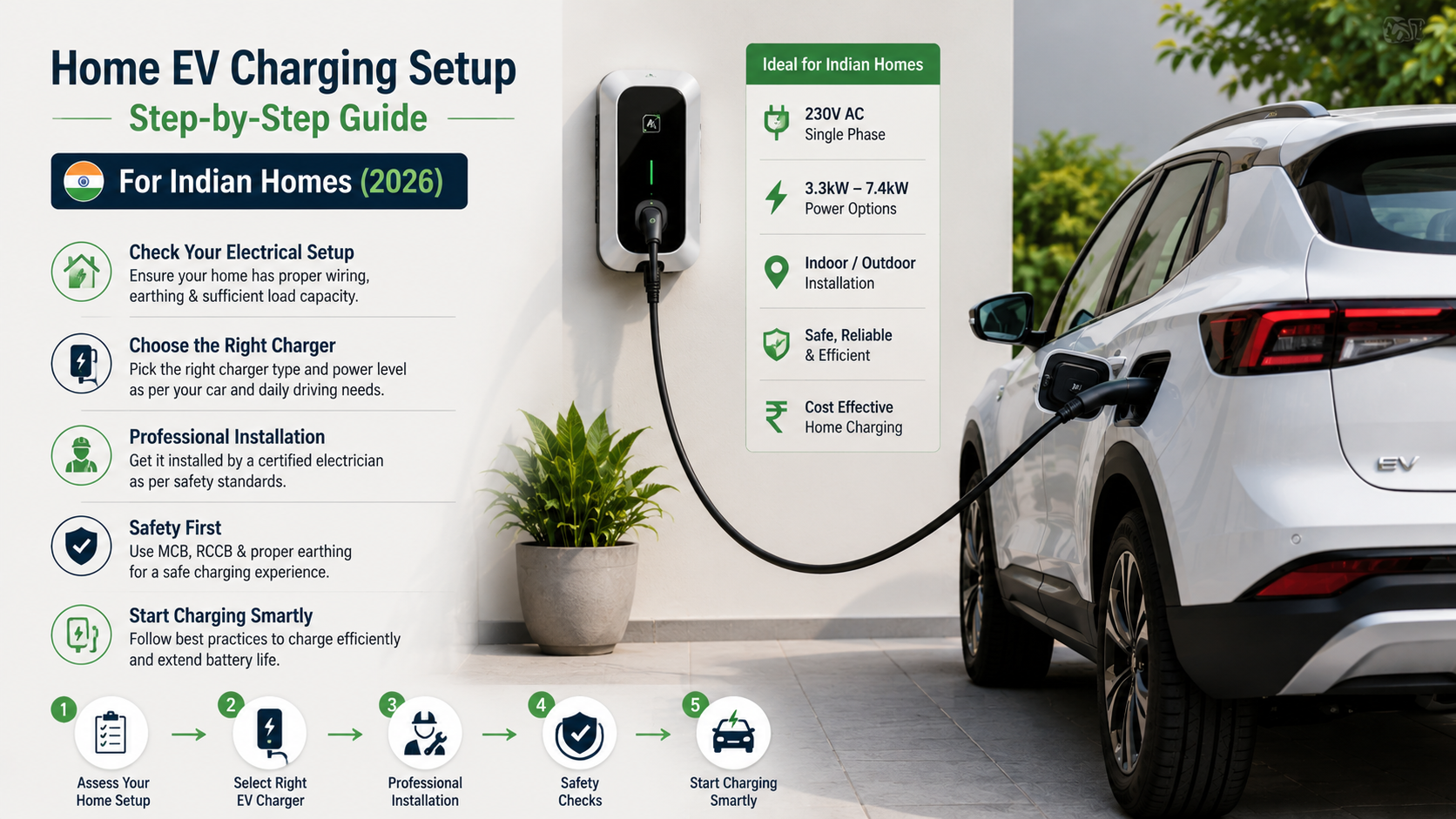
Quick Summary Table
| Feature | Details |
|---|---|
| Charging Location | Home Garage, Parking Area, Covered Parking |
| Power Supply | Single Phase or Three Phase |
| Charger Type | Portable Charger or Wall-Mounted AC Charger |
| Typical Charging Speed | 3.3 kW to 11 kW |
| Installation Cost | ₹10,000 to ₹80,000+ |
| Charging Time | 4 to 15 Hours |
| Electricity Cost per Unit | ₹6 to ₹12 per kWh (varies by state) |
| Safety Requirement | Dedicated Circuit Breaker and Earthing |
| Best For | Daily EV Charging |
Why Home EV Charging Is Important
Most EV owners charge their vehicles overnight. Home charging offers several advantages compared to relying entirely on public charging stations.
Key Benefits
- Charge your car while sleeping
- Lower charging costs
- No waiting at charging stations
- Better battery management
- Increased convenience
- Reduced dependence on public infrastructure
For most Indian drivers, over 80% of EV charging happens at home.
Understanding EV Home Charging Basics
Before installing a charger, it is important to understand how EV charging works.
Electricity flows from your home’s electrical supply into a charging unit, which then safely transfers power to your vehicle’s battery.
The charging speed depends on:
- Charger power output
- Battery size
- Vehicle charging capability
- Household electrical connection
A larger battery generally takes longer to charge than a smaller one.
Types of Home EV Chargers
1. Portable Charger
Most EV manufacturers provide a portable charger with the vehicle.
Features
- Plug-and-play operation
- Uses standard 15A socket
- No complex installation
- Suitable for occasional charging
Advantages
- Included with many EVs
- Easy to carry
- Low setup cost
Disadvantages
- Slow charging speed
- Not ideal for high-mileage users
Best For
- Apartment residents
- Low daily usage
- First-time EV owners
2. Wall-Mounted AC Charger
Wall-mounted chargers are the most popular home charging solution.
Features
- Permanently installed
- Faster charging speeds
- Smart charging options
- Enhanced safety
Available Power Ratings
| Charger Rating | Typical Charging Speed |
|---|---|
| 3.3 kW | Slow |
| 7.2 kW | Moderate |
| 11 kW | Fast AC Charging |
Best For
- Daily commuters
- Multiple EV households
- Long-distance drivers
Key Features to Look for in a Home EV Charger
When selecting a charger, consider the following features.
Smart Connectivity
Many modern chargers offer:
- Mobile app control
- Charging schedules
- Energy monitoring
- Remote operation
Load Management
This feature prevents overloading your home’s electrical system.
Weather Protection
Look for chargers with:
- Waterproof design
- Dust resistance
- Outdoor installation support
Safety Protection
Essential safety features include:
- Over-voltage protection
- Over-current protection
- Short-circuit protection
- Temperature monitoring
Home Electrical Requirements for EV Charging
Many homeowners overlook electrical requirements before purchasing an EV.
Single-Phase Connection
Most Indian homes use single-phase electricity.
Suitable for:
- 3.3 kW chargers
- 7.2 kW chargers
Three-Phase Connection
Required for:

- 11 kW chargers
- Faster charging setups
Useful for:
- Premium EVs
- Larger battery packs
Step-by-Step EV Charger Installation Process
Step 1: Assess Parking Location
Choose a location that offers:
- Easy access to vehicle
- Weather protection
- Nearby electrical panel
Step 2: Check Electrical Capacity
Consult a licensed electrician to determine whether your home’s wiring can support the charger.
Step 3: Install Dedicated Circuit
Experts recommend a dedicated circuit exclusively for EV charging.
This improves:
- Safety
- Reliability
- Charging performance
Step 4: Proper Earthing
Good earthing is essential for EV charging safety.
Never install an EV charger without proper grounding.
Step 5: Charger Installation
A certified technician should install the charger according to manufacturer guidelines.
Step 6: Testing
The charger should be tested for:
- Voltage stability
- Safety compliance
- Charging performance
EV Home Charging Cost in India
The cost depends on the charger type and installation complexity.
Estimated Installation Cost
| Component | Approximate Cost |
|---|---|
| Basic Wiring | ₹5,000 – ₹15,000 |
| Circuit Breaker | ₹2,000 – ₹8,000 |
| Wall-Mounted Charger | ₹20,000 – ₹60,000 |
| Professional Installation | ₹3,000 – ₹15,000 |
| Three-Phase Upgrade | ₹15,000 – ₹50,000 |
Total Cost
Typical home charging setup:
₹10,000 to ₹80,000+
Monthly EV Charging Cost
Let’s take an example.
Suppose:
- Battery size: 40 kWh
- Electricity rate: ₹8/kWh
Full charge cost:
40 × ₹8 = ₹320
If charged 15 times per month:
₹320 × 15 = ₹4,800
Actual costs vary depending on driving habits and electricity tariffs.

Charging Time for Popular EVs
| Vehicle Category | Battery Size | Approximate Home Charging Time |
|---|---|---|
| Small EV | 20-30 kWh | 5-8 Hours |
| Mid-Size EV | 30-45 kWh | 6-10 Hours |
| Large EV | 50-80 kWh | 8-15 Hours |
Charging speed depends on charger capacity and battery condition.
Safety Tips for Home EV Charging
Safety should always be the top priority.
Use Certified Equipment
Avoid low-quality aftermarket chargers.
Avoid Extension Cords
Extension cables can overheat and create fire risks.
Inspect Wiring Regularly
Check for:
- Loose connections
- Damaged cables
- Burn marks
Keep Charger Dry
Even weatherproof chargers should be protected from excessive water exposure.
Schedule Professional Maintenance
Annual inspections can identify potential issues before they become serious.
Smart Charging Tips to Reduce Electricity Bills
Charge During Off-Peak Hours
Some electricity providers offer lower rates during certain hours.
Avoid Frequent 100% Charging
For daily use, charging between 20% and 80% can improve battery longevity.
Use Charging Schedules
Smart chargers can automatically start charging at the most economical time.
Monitor Energy Consumption
Tracking usage helps control electricity costs.
Common Home Charging Mistakes
Many new EV owners make avoidable mistakes.
Using Poor Quality Sockets
Standard household sockets may not handle continuous EV charging loads.
Ignoring Earthing
Improper grounding increases electrical risks.
Overloading Existing Circuits
Multiple heavy appliances on the same circuit can cause problems.
Choosing the Cheapest Charger
Low-cost chargers often compromise safety and reliability.
Skipping Professional Installation
Improper installation can lead to charging failures and safety hazards.
Home Charging vs Public Charging
| Feature | Home Charging | Public Charging |
|---|---|---|
| Convenience | Excellent | Moderate |
| Cost | Lower | Higher |
| Availability | Anytime | Depends on Station |
| Charging Speed | Moderate | Fast |
| Long Trips | Limited | Essential |
| Daily Usage | Best Option | Backup Option |
Most EV owners use a combination of both.
Pros and Cons of Home EV Charging
Pros
- Maximum convenience
- Lower operating costs
- Overnight charging
- Better battery management
- Reduced dependence on charging stations
Cons
- Initial installation cost
- Requires dedicated parking
- Slower than DC fast charging
- Electrical upgrades may be necessary
Comparison of Popular Home Charging Options
| Feature | Portable Charger | Wall Charger |
|---|---|---|
| Cost | Low | Higher |
| Installation | Minimal | Professional |
| Speed | Slower | Faster |
| Convenience | Moderate | Excellent |
| Daily Use | Good | Best |
| Smart Features | Limited | Advanced |
Who Should Buy a Home EV Charging Setup?
A home charging setup is ideal for:
Daily Commuters
People driving 30–100 km per day benefit significantly.
Apartment Owners With Dedicated Parking
If charging access is available, home charging becomes highly practical.
Families With Multiple Vehicles
A dedicated charger can support regular charging needs efficiently.
Long-Term EV Owners
Home charging delivers the best ownership experience and lower running costs.
Expert Analysis
As India’s EV market continues to grow, home charging remains the foundation of successful EV ownership. While public charging infrastructure is improving rapidly, charging at home still provides unmatched convenience and lower operating expenses.
For most Indian households, a 7.2 kW wall-mounted charger offers the best balance between cost, charging speed, and practicality. Buyers should prioritize safety, proper installation, and future expansion rather than simply choosing the cheapest solution.
Investing in a quality home charging setup not only improves convenience but also enhances the overall EV ownership experience for years to come.
FAQ Section
1. How much does it cost to install an EV charger at home in India?
A basic setup can cost between ₹10,000 and ₹30,000, while advanced wall-mounted charging solutions may cost ₹50,000 to ₹80,000 or more.
2. Can I charge my EV using a normal household socket?
Yes, many EVs support charging through a 15A socket using the supplied portable charger. However, charging will be slower.
3. Do I need a three-phase connection for EV charging?
Not always. Most home users can charge efficiently using a single-phase connection. Three-phase power is mainly needed for higher-capacity chargers.
4. Is home EV charging safe?
Yes. When installed professionally with proper earthing, circuit protection, and certified equipment, home charging is extremely safe.
5. How long does it take to charge an EV at home?
Depending on battery size and charger capacity, charging typically takes between 4 and 15 hours.
6. Does daily charging damage the EV battery?
No. Modern battery management systems are designed for regular charging. Following manufacturer recommendations helps maximize battery life.
7. Which charger is best for home use?
A 7.2 kW wall-mounted smart charger is considered the best option for most Indian EV owners.
Conclusion
Setting up a home EV charging station is one of the smartest investments an electric vehicle owner can make. It provides unmatched convenience, lower charging costs, and the freedom to start every day with a fully charged vehicle. While installation costs may seem significant initially, the long-term benefits far outweigh the upfront expense.
Before installation, assess your home’s electrical capacity, choose a certified charger, ensure proper earthing, and hire qualified professionals for setup. For most Indian households, a wall-mounted AC charger offers the ideal balance of speed, safety, and affordability.
As electric vehicles become more mainstream in India, a well-planned home charging setup will not only improve your ownership experience but also prepare your home for the future of mobility.